.svg)

.svg)
.svg)
Tattoo Training in Dresden – Learn to Tattoo from Scratch
You want to learn to tattoo and you are not looking for theory off the internet, but for someone sitting next to you? At Blitz Tattoo Studio in Dresden we train one to one and in very small groups – inside a working studio, on real equipment, with the routines that actually matter day to day. Not a finished career at the push of a button, but a clean, honest start.
What you will learn
Our training is not a video course and not a weekend certificate with a diploma at the end. You work inside the running studio: on practice skin, on the machines we tattoo with every day, and – once you are ready – on real skin under supervision. We go through the whole chain: hygiene and workstation setup, building a design and stencilling, needles and machine settings, line work, shading, how skin behaves, aftercare, and dealing with clients. By the end you should not just be able to pull a line, but know why it sits where it does.
Is there an official tattoo qualification in Germany?
No – and we say that upfront. Tattooing is not a recognised apprenticeship trade in Germany. There is no dual apprenticeship, no chamber-of-commerce diploma and no state certificate. Anyone promising otherwise is selling you a certificate with no legal weight. The craft is learned in practice: from someone who knows it, over months. That is exactly how our training is built – as an entry into real studio work, not as a substitute for a qualification that does not exist.
Who the course is for
For complete beginners who are serious about it, and for career changers who can already draw and need the technical side. You do not need art-school drawing skills, but a feel for line and surface helps a great deal – we look at your work in the first conversation and tell you where you stand. You should be at least 18, with steady hands and patience. Anyone expecting to tattoo after two weeks like someone with two years behind them will be disappointed here.
Course content: from hygiene to your first real skin
We start where many courses fall short: hygiene, disinfection, workstation setup, handling needles and disposal. Then come design build-up, references and stencil transfer, followed by machine work – needle types, voltage, speed, depth. You practise on synthetic skin first, until your lines and shading hold. Only then do you work on real skin under supervision. Running alongside is the part most people underestimate: consultation, pricing, scheduling, and how to handle a nervous client.
One-to-one or small group
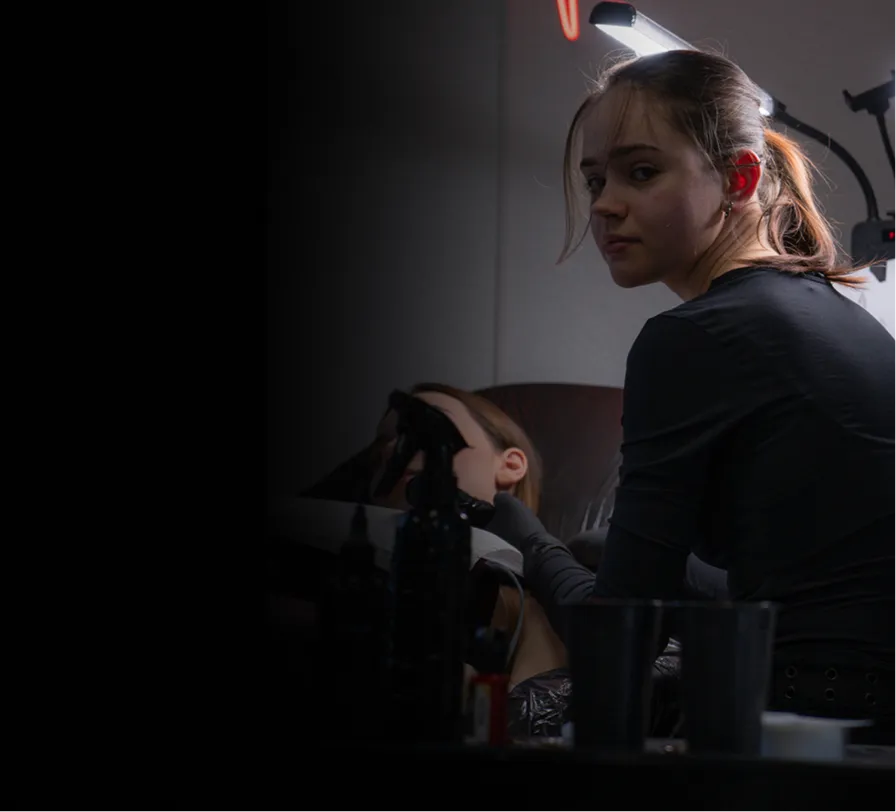
We teach one to one or in very small groups – it does not work any other way, because we need to watch over your shoulder while you tattoo and correct you on the spot. The pace follows you: some people want a few intensive weeks, others spread sessions over months alongside a job. In the first conversation we work out together how many sessions are realistic and how they fit your calendar.
The certificate – and what it is actually worth
You receive a certificate of attendance covering the content and hours you completed. What it is: an honest record of what you did, and a sensible attachment to your portfolio. What it is not: a state licence or a permit to practise – no such thing exists for tattooists in Germany. What gets you into a studio in the end is your portfolio, not the paper. That is why we work deliberately during the training on making sure you finish with pieces worth showing.
What you need to start working as a tattooist
If you want to work independently afterwards, a few formal steps come with it: registering a trade, notifying your local health authority about the studio, a documented hygiene plan, and inks that comply with EU regulations. Hygiene training is the usual proof of competence and is what health authorities expect to see. We go through these points with you during the course so you know what is coming – the registrations themselves are of course yours to handle.
What does tattoo training cost?
Prices in Germany vary enormously: from a few hundred euros for a weekend seminar to five figures for programmes running several months. What matters is not the number but what sits behind it – how many hours you actually tattoo yourself, how many people are supervised at once, and whether you work on real skin. We set our price after the first conversation, because scope and duration are individual. What we will not do is sell you a package you do not need.
📚 5 lessons (1 theory + 4 practical) 💰 €1,500
📚 8 lessons (2 theory + 6 practical) 💰 €2,000
📚 14 lessons (3 theory + 11 practical)
💰 €4,500 ✨ Benefits:
Comprehensive hands-on practice with models, development of your own style, working with clients. Bonus: Basic training in marketing + personal branding.
📚 16 lessons (3 theory + 13 practical)
💰 €7,000 ✨ Benefits:
Maximum professional immersion,
Hands-on experience with major projects,
Creation of a unique portfolio,
Foundational training in marketing + personal branding
🎁 Gift: professional tattoo machine


Additional Services

walk-in
.webp)

custom design
.webp)

COVER UP
.webp)

TATTOO TOUCH-UP
.webp)

INITIAL CONSULTATION
.webp)

ONLINE CONSULTATION
.webp)

GIFT CERTIFICATE
.webp)

CLUB CARD
.svg)
Scar Cover-up Tattoo
FREQUENTLY ASKED QUESTIONS ABOUT OUR SERVICES
Do you need a qualification to work as a tattooist?
How long does it take to learn to tattoo?
Can you learn to tattoo online?
What does a tattoo artist earn?
Do I need my own equipment?
Do I get a certificate after the course?
Ready for your
next tattoo?
Tell us about your idea. Together, we'll design a custom tattoo that's perfect for you.